



Off-roading has its own vocabulary, and most of it gets used without anyone stopping to explain it. Here are 107 terms you will hear on a trail run, in a forum thread, or in a land-use comment period, grouped by where they come up. If a term has a full guide behind it, it is linked.
How people talk about driving
- Airing down. Letting air out of your tires before a trail run so the contact patch grows and the tire conforms to the surface. See our tire pressure guide for numbers by surface.
- Approach angle. The steepest slope you can drive up to before the front bumper hits it.
- Departure angle. Same idea at the back, measured off the rear bumper.
- Breakover angle. How sharp a crest you can cross before the middle of the vehicle grounds out.
- Articulation. How far the suspension can droop and compress, which decides whether a tire stays loaded on uneven ground.
- Flex. Articulation, in conversation.
- Off camber. Driving across a slope rather than up or down it, so the vehicle leans sideways. It is the most common way a rig gets uncomfortable, because the weight shifts to the downhill tires.
- Sidehill. An off-camber stretch of trail.
- High centered. Resting on the frame or skid plates with one or more tires no longer carrying weight, which means no traction even though the engine runs fine.
- Line. The specific path through an obstacle. Picking a line is most of rock crawling.
- Spotter. The person outside the vehicle directing the driver through an obstacle they cannot see. A good spotter gives one instruction at a time.
- Stacking. Building up rocks to change the line, which many areas prohibit because it alters the trail.
- Rock crawling. Very low-speed driving over rock, usually in low range, where throttle control matters more than power.
- Momentum run. Using speed to carry through sand, mud, or a climb. It works until it doesn't, and that is how most damage happens.
- Engine braking. Letting the drivetrain slow you on a descent instead of riding the brakes.
- Throttle control. Metering power so tires turn slowly and keep grip instead of spinning.
- Wheel speed. How fast a tire spins. Low wheel speed finds traction; high wheel speed digs holes.
- Rut. A groove worn into the trail by tires. Deep ruts steer the vehicle for you.
- Trail braiding. New parallel paths forming when drivers go around an obstacle instead of through it, and a leading cause of trail closures.
- Whoops. A series of closely spaced bumps, usually in desert terrain.
- Silt bed. Fine powdered dust deep enough to swallow a tire and hide what is under it.
- Float. Staying on top of soft ground rather than digging in, which is the whole point of airing down on sand.
Drivetrain and four-wheel drive
- 4x4 and 4WD. A system that can drive all four wheels, usually with a low range.
- AWD. All-wheel drive, which sends power to all four wheels automatically but typically has no low range. Which one a road requires is a real question in national parks.
- Transfer case. The gearbox behind the transmission that splits power front to rear and provides low range.
- 4H. Four-wheel drive, high range. Normal trail and slick-road speeds.
- 4L. Four-wheel drive, low range. Multiplies torque and slows everything down.
- Part-time 4WD. A system meant for loose surfaces only, because the front and rear driveshafts are locked together and cannot compensate on pavement.
- Full-time 4WD. A system with a center differential, so it can stay engaged on pavement.
- Crawl ratio. Transmission, transfer case, and axle gearing multiplied together. Higher means slower and more controllable.
- Gear ratio. The axle ratio, such as 3.45 or 4.10. Bigger tires usually mean you need to regear.
- Differential. The gearset that lets the wheels on an axle turn at different speeds. Left alone, it also sends power to the tire with the least grip.
- Locker. A device that forces both wheels on an axle to turn together. Selectable lockers turn on and off; automatic lockers engage on their own.
- Limited slip. A milder differential that biases power toward the tire with grip without fully locking.
- Sway bar disconnect. Releasing the front anti-roll bar to gain articulation at low speed.
- Traction control. Braking a spinning wheel so torque crosses to the other side. It is a partial substitute for a locker.
- Hill descent control. Automated braking that holds a steady crawl downhill.
- G.O.A.T. Modes. Ford's terrain mode selector on the Bronco, short for Goes Over Any type of Terrain. Each mode is explained here.
- Trail Rated. Jeep's badge for vehicles that pass five in-house tests. What the tests actually measure is covered here.
- Death wobble. Violent steering oscillation after hitting a bump, usually caused by worn front-end components rather than by the tires. See the causes and fixes.
- Flat tow. Towing a vehicle on its own four wheels behind a motorhome, also called dinghy towing. Here is how it is done on a Wrangler.
Tires and wheels
- A/T. All-terrain tire. A road-biased compromise that handles gravel and dirt well.
- M/T. Mud-terrain tire. Bigger voids, more bite, more noise. The difference matters more than most people think.
- Bead. The steel-reinforced inner edge of a tire that air pressure holds against the rim.
- Unseating a bead. Losing that seal, usually from low pressure plus a hard sideways load. The tire goes flat instantly.
- Beadlock. A wheel that mechanically clamps the outer bead so very low pressures are practical. True beadlocks are frequently not street legal.
- Load range. A letter, commonly C, D, or E, describing how much load the tire carries and how stiff its sidewall is.
- Sidewall. The side of the tire, and the part that flexes when you air down.
- Section width. How wide the tire is at its widest point.
- Aspect ratio. Sidewall height as a percentage of width, the middle number in a size like 285/70R17.
- Backspacing and offset. Two ways of describing where the wheel mounting face sits, which decides how far the tire sticks out.
- Bolt pattern. The number of lugs and the circle they sit on, such as 5x5. Patterns and torque specs by generation are listed here.
- TPMS. Tire pressure monitoring system. It is required to warn you at 25 percent below placard pressure, so it always lights up when you air down.
- Five-tire rotation. Including the full-size spare in the rotation so all five wear together. The pattern matters.
- Plug and patch. Two different trail repairs, and only one of them is a permanent fix. What plugs actually fix.
Recovery
- Recovery point. An engineered, rated attachment point on the frame. A tie-down hook is not one.
- Kinetic rope. A stretchy recovery rope that stores energy and releases it to pull a stuck vehicle free.
- Snatch strap. The same idea in webbing form.
- Tow strap. A non-stretch strap for towing, not for yanking. Mixing the two up is how people get hurt.
- Soft shackle. A synthetic loop that connects recovery gear without the mass of a steel shackle.
- Bow shackle. The steel U-shaped connector with a threaded pin.
- Winch. A powered drum that pulls the vehicle toward an anchor.
- Fairlead. The guide the winch line passes through, either rollers for steel cable or a smooth hawse for synthetic.
- Snatch block. A pulley that redirects a winch line and doubles the pulling power when the line comes back to the vehicle.
- Tree saver. A wide strap that anchors to a tree without cutting into the bark.
- Deadman anchor. A buried object used as an anchor point where nothing else exists.
- Traction boards. Stiff ramps you wedge under a tire to bridge soft or slick ground.
- Hi-Lift. A tall farm-style jack that can lift, winch, and clamp. It is also the most dangerous tool most people carry, and a bottle jack is often the better choice.
- Self-recovery. Getting unstuck without another vehicle.
- Recovery kit. The bag that holds the above, alongside tools and a first aid kit.
Land, access, and navigation
- OHV. Off-highway vehicle. The legal term agencies use, and the word you look for on signs and maps.
- MVUM. Motor Vehicle Use Map. The Forest Service map that says which roads and trails are legally open, and to what.
- BLM. Bureau of Land Management, which administers much of the public land open to dispersed use in the West.
- Dispersed camping. Camping outside a developed campground on public land where it is allowed. The rules vary by agency.
- Staging area. The lot where people air down, air up, and meet before a run.
- Trailhead. Where the trail begins.
- Trail rating. A difficulty scale, often easy, moderate, difficult, or a numbered system. Ratings are local, so a 6 in one area is not a 6 in another.
- Badge of Honor. Jeep's program that awards a badge for completing specific trails. There are 105 of them in 2026.
- Stay the trail. The rule underneath every access argument. Driving only on designated routes.
- Tread Lightly. The nonprofit whose ethics guidance most agencies and clubs reference.
- Roadless Rule. The federal rule governing road building on roadless National Forest land, and open for public comment through October 6, 2026.
- Travel management. The process by which a forest decides which routes stay open, closed, or seasonal.
- Topo map. A topographic map showing elevation by contour lines. Free sources exist.
- Waypoint. A single saved coordinate.
- Track. A recorded breadcrumb trail of where you actually drove.
- GMRS. General Mobile Radio Service, the licensed radio band most trail groups now use to talk between rigs.
- CB. Citizens Band radio, the older standard, still common on organized runs.
- Satellite messenger. A device that sends texts and an SOS through satellites where there is no cell service.
Overlanding and camp
- Overlanding. Vehicle-based travel where the journey and self-sufficiency are the point, not the obstacle. Here is how it differs from off-roading.
- RTT. Roof top tent. Fast to deploy, heavy, and it raises your center of gravity. Worth comparing against a ground tent.
- Awning. A fold-out shade panel mounted to a rack or roof rail.
- Dual battery. A second battery that runs the fridge and lights without stranding you.
- GVWR. Gross vehicle weight rating: the maximum the vehicle is rated to weigh when loaded. Easier to exceed than most people expect.
- Payload. What is left of that rating after the vehicle itself, and the number that actually limits your packing.
- MOLLE. The webbing grid used to attach pouches to panels and seat backs.
- Jerry can. A rectangular fuel or water can, named for its World War II origin.
- Spare tire carrier. The mount that holds a full-size spare, usually on the tailgate or a rear bumper swing-out.
Cover the spare


Community and culture
- Rig. Your vehicle, once it is set up for this.
- Wheeling. Going off-road, as a verb.
- Trail run. An organized group outing.
- Tail gunner. The last vehicle in a group, responsible for making sure nobody is left behind.
- Trail leader. The rig up front setting pace and line.
- The Jeep wave. The greeting between Jeep drivers, with its own unwritten rules.
- Ducking. Leaving a rubber duck on another Jeep as a compliment. The tradition started in 2020.
- Trail etiquette. Who yields to whom, how to pass, and what to do at a gate. Our etiquette guide covers the ones that cause arguments.
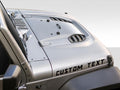
- Easter egg. A small design detail hidden by the manufacturer, like a molded gecko or a map outline.
- TJ, JK, JL, JT. Wrangler and Gladiator platform codes rather than trim names. Every generation, by model year.
Frequently asked questions
What does off camber mean in off-roading?
Off-camber means driving across a slope instead of straight up or down it, so the vehicle leans to one side. Weight shifts onto the downhill tires, which reduces grip on the uphill side and raises the risk of a rollover on steep ground. Slower speed and a line that keeps the lean shallow are the fixes.
What is the difference between off-roading and overlanding?
Off-roading is about the terrain itself, where the obstacle is the point. Overlanding is vehicle-based travel where the distance and self-sufficiency are the point, and the rough road is just how you get there. Plenty of people do both in the same rig.
What does OHV stand for?
Off-highway vehicle. It is the legal term land agencies use on signs, maps, and regulations, so it is the word to look for when you are working out what is open and to whom.
How are off-road trails rated?
Most areas use either a word scale such as easy, moderate, and difficult, or a numbered scale. Ratings are set locally, so they are not comparable between regions. A 6 in Moab and a 6 in Pennsylvania can be very different trails, which is why the local land manager or trail guide matters more than the number.
What does airing down mean?
Letting air out of your tires before a trail run so the contact patch gets longer and the tire conforms to the ground. Published ranges vary by surface, from about 18 to 26 psi in sand up to 28 to 34 psi on faster dirt roads, and our tire pressure guide lists the numbers by surface with sources. The tradeoff is heat, vague steering, and a weaker grip on the wheel bead.
What is a spotter?
The person outside the vehicle guiding a driver through an obstacle they cannot see over the hood. A good spotter stands where the driver can see them, gives one instruction at a time, and takes responsibility for the line.
Jeep Decal Store is a veteran-owned shop in South Carolina. Free shipping on orders over $59.99, and you can browse every spare tire cover design here.
0 comments