



A locker is the single biggest traction upgrade you can bolt to a 4x4. It will take a stock rig up lines that modified trucks walk away from. It will also snap an axle shaft in about a second and a half if you use it in the wrong place.
Both of those things are true at the same time, and the second one is what nobody covers. Here are eight situations where the lockers should stay off, why each one hurts, and where they actually earn their keep.
What a locker actually does
An open differential lets your two wheels on an axle turn at different speeds. That is not a flaw; it is the entire point. When you go around a corner, the outside wheel travels farther than the inside wheel. Without a differential, something has to give, and that something is your driveline.
The tradeoff shows up off pavement. An open diff sends torque to the wheel with the least grip, so the moment one tire lifts or hits ice-slick mud, that tire spins and the one with traction gets nothing.
A locker forces both wheels on the axle to turn at the same rate no matter what. The spinning tire can no longer steal the torque. That is why a locked stock rig outperforms a lifted one on big tires that has open diffs.
It also means that every time the two wheels want to turn at different speeds and cannot, that difference has to go somewhere. It winds up as twist inside your axle shafts, U-joints, and gears. Off-roaders call it bind, and bind is the villain in most of what follows. If any of this vocabulary is new, our off-road terms glossary covers the rest.
1. At speed, with a load on the driveline
Momentum is a real technique. Combining it with lockers is how you find your driveline's weakest component.
Towing up a steep grade, hitting an obstacle at speed, or accelerating hard with everything locked puts a shock load through parts sized for a stock vehicle on pavement. It may not break today. It breaks eventually, and it tends to break somewhere with no cell service.
If speed is your plan, the lockers are the wrong tool. Pick one.
2. On high-traction ground that is smooth and flat
This is the one people get wrong most often, because it feels harmless. Hard-packed dirt road, slickrock flat, a graded forest service road. Grip is good, the surface is even, and nothing is lifting a tire.
That is exactly the problem. Bind only releases when a wheel breaks traction or lifts off the ground. On a high-grip flat surface, nothing releases. The tension just accumulates in your driveline while you scrub the edges off your tires.
Same reason you do not lock the center diff or run 4WD on dry pavement. Unlock and drive.
3. In high range
Most factory lockers will only engage in 4-Low, and that is a design decision, not a limitation to work around. Some aftermarket lockers will let you engage in 2WD or 4-High. Do not take them up on it.
In low range, you have the gearing to creep, feather the throttle, and load the driveline gently. In high range, you start in a taller gear and shift, which multiplies shock loading through everything behind the transfer case. Add the speeds high range invites and a front locker becomes a genuine safety problem, not just a mechanical one.
4. When momentum is the actual answer
Lockers are for controlled, deliberate, slow driving. Feather-footing a rock step. Creeping through a rut. Walking out of soft sand in first low.
If the obstacle calls for a run-up, you have already decided that speed is doing the work. Traction isn't your limiting factor, so the locker adds stress without adding capability.
5. Mid-corner with the front locker
A locked front axle is a steering locker. Both front wheels are forced to turn at the same rate, which is the opposite of what steering requires.
If a climb has a bend in it, you will reach the turn and discover the rig will not take the line. If it does turn, it will fight you the whole way and load the front end badly. Locked front is for straight lines.
Use it when a section genuinely needs it, then turn it off. And turn it off early, because lockers can take a moment to actually disengage. Get it out before you need to steer, not while you are steering.
6. Downhill with the front locker
Never. Going downhill, gravity has already shifted weight onto the front axle, which is the weaker of the two. Locking it there stacks bind and load onto the part least able to take it, and it tightens up your steering at the exact moment you want the most control.
The rear locker downhill is the opposite story. If a hill is steep enough that you want low range to descend it, the rear locker helps hold the rig straight. Sand, mud ruts, loose rock, it does not matter much. Rear locker on, front locker off.
7. At full steering lock with the front locker
A locked front axle at full steering lock puts enormous stress into your CV joints and axle shafts. You are asking parts already at their worst operating angle to transmit torque they cannot split.
If you are running a front locker in a difficult spot, keep the wheel between straight and about half lock. Past that, the math stops working in your favor.
8. On a loose side slope
This one is counterintuitive, and it matters. On an off-camber slope of loose sand or scree, leave the lockers out.
With an open diff, the uphill wheel spins more than the downhill wheel, because the weight has transferred downhill and the uphill tire has less resistance. That spin is harmless. Lock it, and both wheels drive together against a surface that cannot hold them, and the whole rig slides sideways down the hill. Think of a car doing a burnout and going where it did not intend to.
The one that costs axles: locking up when you are already wedged
You stop moving. The instinct is to lock everything and add throttle.
If you are on hard ground and you do not know what is holding you, get out and look first. If the rig is physically wedged on rock, locking the diffs does not add traction. It removes the last escape path the driveline had, so the torque has nowhere to go but into twisting metal. That is how people come home with a twisted axle shaft and a sheared flange.
Look first. Move the obstacle, change the line, or strap it down.
Where lockers actually earn their keep
Low traction, low speed, low range. That is the whole recipe.
- Soft sand. Starting to dig in? First gear low with the rear locked will often let you creep and wiggle out before the traction boards come off the rack.
- Mud and loose rock. Anywhere a wheel will spin up uselessly.
- Uneven high-traction ground. Rock step-ups are fine, and this is the exception to rule 2. Because wheels are lifting and setting down constantly, bind releases as fast as it builds.
- Steep descents. Rear locker only, for stability.
Lockers are not a substitute for correct tire pressure, and on sand the pressure matters more. Our airing down guide covers what to run on each surface. Modern rigs with limited suspension travel lift wheels constantly, which is why lockers do so much for them and why bind is less of a worry on genuinely rough ground than on smooth ground.
How it works on a Rubicon
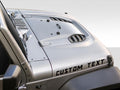
If you are running a Wrangler Rubicon, the Tru-Lok system makes several of these decisions for you, and it is worth knowing the rules before you are on the trail wondering why the light is blinking.
Per Jeep's owner documentation, the axle lock will only engage when the vehicle is in 4WD Low, moving at 10 mph or less, with both wheels on the axle turning at the same speed. Push the AXLE LOCK switch down for rear only. Push it up for front and rear together. Take it out of 4-Low or shut the ignition off, and the lockers disengage.
Note what is missing from that list: there is no front-only setting. You get rear, or you get both. So the advice about using a front locker by itself does not apply to a factory Rubicon. Your practical choice is rear-only most of the time, stepping up to front and rear for a short straight section that genuinely needs it, then dropping straight back to rear only.
That constraint is not Jeep being stingy. It is the same reasoning as everything above, built into the switch.
Do you need both?
No. A rear locker alone covers most of what most people do. A front locker alone works for some. Both together is the strongest traction setup you can have, and it is also the one that demands the most discipline about when to turn things off.
What matters far more than how many lockers you own is whether you know when to leave them out. The rig that comes home under its own power is the one that got that part right.

Frequently asked questions
Can you use diff lockers on pavement?
No. Pavement is the highest-traction surface you will drive on, so bind builds in the driveline with no way to release. It causes tire scrub, hard steering, and eventually a broken component. Unlock before you air up and head home.
Why do lockers only work in 4-Low on most vehicles?
Low range gives you the gearing to move slowly and load the driveline gently, which is the only way to use a locker. High range invites speed and harder shifts, which multiply shock loading. On a Jeep Wrangler Rubicon, Tru-Lok will only engage in 4WD Low at 10 mph or less.
Is it bad to use the front locker going downhill?
Yes. Gravity has already loaded the front axle, which is the weaker of the two, and locking it adds bind on top of that load while reducing your steering control. Use the rear locker for descents and leave the front one off.
Why does my Jeep slide sideways on a hill with the lockers on?
On a loose off-camber slope, locking the axle makes both wheels drive together against a surface that cannot hold them, so the rig slides downhill. Unlocked, the uphill wheel spins harmlessly, and you keep your line. Leave the lockers out on loose side slopes.
Do I need a front locker?
Most people do not. A rear locker handles the majority of trail situations and carries far less risk of misuse. A front locker adds real capability on straight, difficult climbs, but it restricts steering and stresses CV joints, so it demands more discipline about switching it off.
Can a locker break my axle?
Not on its own. Lockers break axles when combined with speed, load, or a physically wedged vehicle, because the bind they create has nowhere to escape. Slow, deliberate use in low range is what they were designed for.
0 comments