


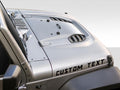

A 2018 or newer Jeep Wrangler, the JL generation, comes with ten features most new owners never fully use: removable doors, a fold-down windshield, three different tops, a two-speed transfer case, and on Rubicon and a few other trims, an electronic sway bar disconnect, Tru-Lok lockers, Off-Road+ mode, a forward-facing TrailCam, four programmable auxiliary switches, and a 30-inch water fording rating (34 inches with 35-inch tires). Here is how each one works and the limits Jeep puts on it, taken from the Wrangler owner's manual and Jeep's own spec sheets, so the numbers (18 mph for the sway bar, 60 mph for the power top, 25 mph in 4WD Low, 5 mph in water) are the ones Jeep publishes.
In this article
- 1. Removable doors
- 2. Fold-down windshield
- 3. The three tops
- 4. Transfer case: 4H, 4L, and Selec-Speed
- 5. Electronic sway bar disconnect
- 6. Tru-Lok locking differentials
- 7. Off-Road+ mode
- 8. The forward-facing TrailCam
- 9. Auxiliary switches
- 10. Water fording, skid plates, and tow hooks
- Frequently asked questions
1. Removable doors
Every JL ships with the tools to remove its own doors: a T50 Torx driver, a T40 Torx driver, a 15 mm socket, and a ratchet in the center console, per the 2021 Wrangler owner's manual, with the bit size stamped on the hinge. The doors are aluminum with a lift-assist pull cup under each armrest, as Jeep noted when it introduced the 2018 Wrangler. The manual's front door procedure: roll the window down, remove the upper and lower hinge pin screws with the T50, slide (never pry) the wiring access cover under the dash toward the seats, unplug the harness (pull up the red locking tab, hold the black security tab, and pull the connector down), remove the door check strap screw with the T40, then lift the door straight up off its hinge pins with a helper. Reinstall in reverse, and keep hinge pin torque under 7.5 ft lb.
The catch: the mirrors are bolted to the doors and leave with them. The manual states that federal law requires outside mirrors for on-road use and points owners to a cowl-mounted replacement. The doors-off legality article on this site covers the rules state by state.
2. Fold-down windshield
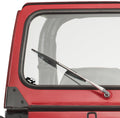
The JL windshield folds on four Torx screws, and the header bar tying the A-pillars together stays up, so the rearview mirror stays put, and only the glass goes down. Per the manual, you must lower the soft top and remove its door rails first, and you must remove the hardtop's Freedom panels, or the header seal gets damaged. Then: pop the caps off the wiper arm bolts and remove the arms with the 15 mm socket, lower both visors, remove the four Torx screws along the top of the windshield with the T40, thread them back into their holes for safekeeping, lower the glass onto the tie-down bumpers, and strap it to the hood tie-downs, snug but not cranked.
The manual recommends 10 mph with the windshield folded, eye protection for everyone, and no on-road driving with it down. With the Sky One-Touch power top, leave the windshield alone: folding it damages the top and the header seal.
3. The three tops
| Top | Availability | How it opens | Best for |
|---|---|---|---|
| Premium Sunrider soft top | Standard on the 2024 Sport; the soft top option across the line | Front section flips back by hand; the whole top folds or comes off | Fastest open-air access, lightest |
| Freedom Top three-piece hardtop | Black on all trims; body-color on Sahara and Rubicon, standard on 2024 Rubicon X | Two front panels unlatch by hand and store in a bag; the rear section needs four adults to lift | Cold climates, highway quiet, security |
| Sky One-Touch power top | Four-door models only; standard on 2024 High Altitude | Full-length canvas panel slides back at a switch; rear quarter windows lift out; the top is not removable | Open-air driving without leaving the seat |
Sunrider. Fold both visors forward, pull the header latch handles down, lift the number one bow from both sides, and use the side link to fold the top back into the Sunrider position. The rear and quarter windows must come out before the top folds all the way down.
Freedom Top. Driver's side first: fold the visor, turn the three L-shaped locks on the left panel, release the header latch at the top of the windshield, lift the panel out, then repeat on the right.
Sky One-Touch. Press and release the switch right of the driver's visor for a full open or close. The manual lists three hard limits: it will not operate above 60 mph, it will not open below minus 4 degrees F, and it cannot be removed. The 2022 Wrangler fact sheet lists it as four-door only.
4. Transfer case: 4H, 4L, and Selec-Speed
Which transfer case a JL has depends on trim, per the 2024 Wrangler specifications and the 2024 launch release.
| Transfer case (2024) | Type | Positions | Low range | Trims |
|---|---|---|---|---|
| Command-Trac NV241 | Part-time | 2H, 4H, N, 4L | 2.72:1 | Standard on Sport and Sahara |
| Selec-Trac MP3022 | Full-time | 2H, 4H Auto, 4H, N, 4L | 2.72:1 | Standard on Rubicon 392, High Altitude, and Willys 4xe; optional on Sport and Sahara |
| Rock-Trac NV241OR | Part-time | 2H, 4H, N, 4L | 4.0:1 | Standard on Rubicon |
| Rock-Trac MP3022OR | Full-time | 2H, 4H Auto, 4H, N, 4L | 4.0:1 | Optional on Rubicon; standard on Rubicon X |
2H is for normal street driving. 4H locks the front and rear driveshafts together so all four wheels turn at the same speed, which the manual limits to loose, slippery surfaces: snow, sand, wet gravel, mud. 4L does the same through the low-range gears for crawling, steep grades, and water crossings; the manual caps it at 25 mph, where engine speed runs about three times higher than high range, or four times on a Rubicon. 4H Auto, on the two full-time cases, drives the rear wheels until it senses slip and is the only 4WD setting meant for dry pavement.
Shifting: 2H to 4H works stopped or rolling, preferably at 0 to 45 mph. 4H to 4L is different: roll at 1 to 3 mph, put an automatic in Neutral or push in the clutch, pull the lever firmly through without pausing in N, then go back to Drive. Never run a part-time case in 4H or 4L on dry pavement: with the driveshafts locked together, the manual states, it causes increased tire wear and driveline damage.
Jeep's 2018 Wrangler powertrain release lists 84.2:1 for a Rubicon with the six-speed manual and 77.2:1 with the eight-speed automatic (4.71 first gear, 4:1 low range, 4.10 axle). The 2024 release quotes crawl ratios up to 100:1, which takes the optional 4.88 axle the 2024 spec sheet lists for 3.6-liter Rubicons. The gear ratio calculator on this site runs the math for any combination.
Selec-Speed Control is cruise control for low range, and it only works in 4L. Push the SSC button at under 5 mph; once the driver is off both pedals, it holds a set speed with engine torque and brakes, from 0.6 mph in first to 5 mph in eighth on the shifter's plus and minus taps.
5. Electronic sway bar disconnect
The front sway bar keeps the body flat in corners, and that same stiffness limits articulation on a rock. Rubicons get a SWAY BAR switch right of the steering column that splits the bar electrically. Per the manual: shift into 4H or 4L first, because the switch does nothing in 2H, then push it. The Sway Bar Indicator Light flashes while the bar unlocks and goes solid once it is fully disconnected. If it keeps flashing, the bar halves are torque-locked; rock the Jeep side to side so they line up. Push the switch again to reconnect before returning to pavement.
The speed rule: the system tries to reconnect the bar on its own above 18 mph, and it only returns to off-road mode once speed drops under 14 mph. The manual's warning is blunt: a disconnected bar above 18 mph or on pavement can contribute to loss of control.
6. Tru-Lok locking differentials
An open differential lets a tire in the air spin while the one on the ground does nothing; Tru-Lok lockers force both wheels on an axle to turn together. The 2024 spec sheet lists them front and rear on Rubicon models in Dana 44 axles, and the 2024 launch release made a rear Tru-Lok standard on the Willys.
The AXLE LOCK switch sits beside the sway bar switch: push the bottom for REAR ONLY, the top for FRONT + REAR, and AXLE LOCK OFF to release. The manual's conditions are ignition on, 4L, 10 mph or less, and both wheels on the axle turning at the same speed. The lockers release on their own above 30 mph, relock under 10 mph, and drop out if the case leaves 4L.
Rear first, front only when needed: a locked front axle pushes the Jeep straight ahead and fights the steering. The When Not to Use Lockers article on this site covers situations where they hurt more than help.
7. Off-Road+ mode
Off-Road+ is one button in the switch bank that retunes the throttle map, the shift schedule, and the traction control for dirt. Jeep made it standard on the Rubicon for the 2021 model year. It does nothing in 2H; press it there, and the cluster says to shift to 4WD. What it does depends on the range, per the manual:
- In 4L, rock-crawl tuning: the pedal is de-gained, shift points change for crawling, and the brake-based traction control gets aggressive at low speed. The setting is remembered across ignition cycles.
- In 4H, sand tuning: an aggressive pedal, a sport shift schedule, slip-tolerant traction control, and stability control off with no speed cap. This one defaults to off at every restart.
On a Rubicon, 4H plus Off-Road+ plus ESC fully off is the one combination that lets the rear locker engage in high range, for a fast sand run with a locked rear and a free-steering front.
8. The forward-facing TrailCam
On a steep climb, the hood hides the trail; the TrailCam puts a front-of-the-Jeep view on the touchscreen with a "Check Entire Surroundings" banner. Jeep added it for the 2021 model year with the 8.4-inch screen; 2024 and newer Wranglers run it on the 12.3-inch Uconnect 5 display, where the 2024 release lists it as standard on High Altitude, Rubicon X, and Rubicon 392, and Jeep's fact sheets describe it as offered on other models with the larger touchscreen.
Bring it up with the FWD Camera button, the Forward Facing Camera app, or the TrailCam button inside Off-Road Pages. In 4L, the image stays on as long as the driver wants it; in 2H or 4H, it stays on under 8 mph, and above that, a 10-second timer clears it. For a muddy lens, press and hold the Clean Camera button, and washer fluid sprays the lens for as long as you hold it, up to 20 seconds per press.
9. Auxiliary switches
A row of four extra switches in the lower bank of the dash, standard on the 2024 Rubicon and optional equipment otherwise, is a factory-wired accessory circuit. Each switch runs a relay that powers a blunt-cut wire, and the four wires are available in two places: under the dash on the passenger side and under the hood on the right, next to the battery. Two circuits are fused at 40 amps and two at 15 amps. Jeep includes a splice kit, so nothing gets cut into a factory harness.
Uconnect settings control each switch three ways, per the manual:
- Latching or momentary. Latching stays on with a press; momentary runs only while held, which is right for a winch.
- Battery or ignition. Battery power stays live with the Jeep off, which a fridge needs, and a forgotten light bar will drain; ignition power cuts off with the key.
- Hold last state. Whether a switch comes back on after a restart; it applies only to latching switches on ignition power.
10. Water fording, skid plates, and tow hooks
Jeep rates every 2024 Wrangler trim at 30 inches of water fording, and the 35-inch-tire models, the Xtreme 35 Package and the Rubicon 392, at 34 inches, per the 2024 spec sheet. On every trim, the manual's warning is the same: too fast or too deep and water gets into the axles, transmission, transfer case, engine, or cabin.
The manual's method is low and slow: 4L, first gear or Drive, a constant 3 to 5 mph, light throttle, and keep moving without trying to accelerate through. Check the depth first by walking it or probing with a stick; a soft bottom sinks the Jeep deeper than measured. If the engine stalls in water, do not restart it until it is clear the intake did not swallow any, and after any crossing deeper than the axle differentials, check every fluid for water.
Underneath, the 2024 release lists four skid plates and tow hooks (two front and one rear) in the spec list behind every Wrangler's Trail Rated badge; the 2018 launch release names the fuel tank, transfer case, and automatic transmission pan as what the plates cover. The Trail Rated badge article on this site explains the five tests behind the badge.
Frequently asked questions
Can you drive a Jeep Wrangler JL with the doors off?
Mechanically, yes, and the tools come with the Jeep. The owner's manual says the procedure is for off-road use and that federal law requires outside mirrors on the road, so the mirrors that leave with the doors need to be replaced with a cowl- or hinge-mounted set first.
How fast can you go with the sway bar disconnected on a Rubicon?
Under 18 mph. The system tries to reconnect the bar on its own above 18 mph, and it will not disconnect again until speed drops under 14 mph.
Can the Sky One-Touch power top be opened while driving?
Yes, up to 60 mph; the manual states the top will not operate above that speed. It also will not open below minus 4 degrees F, and you can't remove the top.
How deep can a Jeep Wrangler JL go in water?
Jeep rates the 2024 Wrangler at 30 inches on standard tires and 34 inches with the 35-inch tires of the Xtreme 35 Package or Rubicon 392. That is for still water of known depth, crossed in 4L at 3 to 5 mph.
Do all Wranglers have lockers?
No. Tru-Lok front and rear lockers are standard on Rubicon models, and for 2024 the Willys gained a standard rear Tru-Lok. Sport and Sahara use open differentials with an available Trac-Lok limited-slip in the rear.
Related reading on this site: Is it legal to drive a Jeep without doors?, When not to use diff lockers, Jeep gear ratio calculator, The Jeep Trail Rated badge explained.

0 comments