



The last Jeep Wrangler TJ rolled off the line in July 2006. Twenty years later, they are still on the hard trails in numbers that make no sense for a vehicle that old, and prices have gone up rather than down. Both are true, and a TJ purchase can go badly wrong in two ways.
Here is the honest version, including who should not buy one.
The short answer
Yes, if you are buying it to wheel. A TJ is short, narrow, light, and simple, and those four things still win on technical trails. Buy a 2003 to 2006 if the budget allows, check the frame before you check anything else, and accept that it is a poor daily driver by modern standards.
No, if you want one vehicle that does everything. A TJ is loud, the ride is firm, the back seat is a penalty box, and the safety equipment is from another era. None of that is a defect; it is just what the truck is.
Why it still wins off-road
The TJ ran from model year 1997 to 2006, and its defining change from the YJ before it was the suspension: coil springs front and rear instead of leaves. That is what gives a TJ its articulation, and it's why a stock one keeps tires on the ground where a leaf-sprung Jeep lifts a wheel.
The other advantage is a number nobody markets: a 93.4-inch wheelbase. Short means better breakover, tighter turns between trees, and the ability to place the vehicle where a longer truck simply cannot go. The Unlimited, the LJ, arrived in April 2004 with a 103.4-inch wheelbase and trades some of that agility for stability and space. Both are good. They are good at different things.
Add solid axles at both ends, a narrow body, and low weight, and you have a package that is still competitive on rock and in ruts against vehicles built two decades later. If you want the full family tree, our guide to Wrangler generations lays out every one from the CJ forward.
The 4.0, and why people will not shut up about it
This is the real reason the TJ holds its value, and the reputation is earned, not nostalgic.
The 4.0-liter inline six makes 190 horsepower and 235 pound-feet of torque. The horsepower number looks weak on a spec sheet, and it does not matter, because the torque arrives low and stays flat, which is the only part of an engine curve that wheeling actually uses. You are not drag racing. You are trying to move three thousand pounds up a ledge at walking speed.
The engineering underneath is the part that matters at high mileage. It is an AMC design with a cast iron block, and it runs a timing chain rather than a rubber belt, so there is no service interval where a snapped belt destroys the engine. There is no complicated variable valve system, no turbo, and no integrated electronics module that takes the whole truck down when it fails.
What that buys you in practice is not immortality. It is fixability. Nearly everything on a TJ is a bolt-on part you can get locally, the wiring is simple enough to trace, and you can do the work on a Saturday with hand tools. That is worth more on a twenty-year-old vehicle than any reliability rating, because everything eventually breaks. What matters is whether you fix it in your driveway or wait three weeks for a dealer appointment.
The four-cylinder is the trap
Not every TJ has the 4.0. From 1997 to 2002 the base engine was a 2.5-liter four, and from 2003 to 2006 it was a 2.4-liter PowerTech making 147 horsepower and 165 pound-feet. They are cheaper to buy, and on a stock TJ with small tires, they are adequate.
The problem shows up the moment you build the truck. This is firsthand: the shop owner's 1997 TJ came with the four-cylinder, and after a set of tires, a lift, and bumpers, it simply didn't have the power to move what it had become. Every pound you bolt on is a pound the four has to carry, and the modifications people buy a TJ to make are exactly the ones it cannot absorb.
The fix was a 2006 4.0 swapped in, sourced from somebody pulling theirs to do an LS swap, which is a common way these engines come up for sale. Worth knowing before you plan one: it is not an engine swap; it is a driveline swap. That job needed a different transmission, new motor mounts, and the computer. The four-cylinder cars ran the AX-5 behind them, which was never built for what the six makes, so the gearbox goes with the engine. It was later built out into a 4.6 stroker, for the reason most people do anything to a Jeep: bigger seemed better.

So the advice is simple, and it comes from having done it the long way round: check the frame first, then buy a six-cylinder. A swap is absolutely doable, and people complete them every weekend. It is just a lot more work and money than paying the difference for a 4.0 at purchase.
If 190 horsepower is not enough: the 4.6 stroker
The 4.0 has one honest weakness, and it shows up the moment you build the truck. Bigger tires, a lift, and steel bumpers all add weight and rotating mass, and 190 horsepower that felt fine on 33s starts feeling thin on 35s. The usual answer is a V8 swap. There is a cheaper, far less invasive option.
A 4.6 stroker keeps the 4.0 architecture and adds displacement with a longer-stroke crankshaft. It is still an inline six; it still sits on the same mounts, and it still uses the wiring and accessories you already have. What changes is the part you actually feel.
Taking the best-known crate version as the benchmark, Golen Engine Service publishes 270 horsepower and 300-plus pound-feet of torque for its 4.6, against the 190 and 235 the factory 4.0 makes. Compression is 9.5:1, and the usable range runs from idle to 5200 rpm, which tells you where the engine is meant to live. It is not a high-revving build. It has the same flat, low-torque curve the 4.0 is loved for, with more of it.
Two numbers to go in with your eyes open about. Golen lists its complete engine at $7,999 for 1991 to 1999 and $8,199 for 2000 to 2006, with a one-year, no-mileage-limit warranty. You will see older videos quoting six thousand and a three-year warranty. Check the current page before you budget, because those numbers have moved. Prices checked September 2026.
What that buys is a complete engine rather than a project: a Callies cast steel crankshaft, aftermarket forged steel rods, and it ships with the gasket kit, oil pan, timing cover, valve cover, damper, Bosch injectors, break-in oil and filter, a spec sheet, and a setup guide. The rest carries over from your old engine, which is exactly why this is a weekend or two of work rather than the months a V8 conversion turns into.
The honest case for it over a V8: no driveshaft changes, no custom mounts, no cooling system redesign, no exhaust fabrication from scratch, and nothing that makes the truck harder to diagnose at a normal shop. You keep the thing that made the TJ worth buying, which is that you can still work on it yourself, and you fix the one thing the platform was genuinely short on. A stroker is also the rare modification that suits a built TJ better the more you have already done to it.

Is the Rubicon worth the premium?
For off-road use, usually yes, and the math is simple.
The Rubicon arrived in 2003 with front and rear Dana 44 axles with air-actuated Tru-Lok lockers and the Rock-Trac NV241 transfer case with a 4:1 low range. A standard TJ has a Dana 35 in the rear and a 2.72:1 low range. Adding real lockers front and rear plus a 4:1 case to a non-Rubicon costs thousands and a lot of labor, and you still end up with a lighter rear axle unless you swap that too.
So the Rubicon premium is not collector tax. You are buying the modifications the factory already did, with the warranty history and the right parts. If you plan to wheel it hard, that is the version to hunt for.
What to check before you hand over money
The frame, first and always. Rust is the one problem here that can write off the vehicle. Look at the rear section behind the fuel tank, the rear shackle mounts, and the front lower control arm mounts. Bring a flashlight and something to poke with. A whole industry exists selling weld-in repair plates for these frames, which tells you how common it is. A TJ that lived somewhere they salt the roads deserves more suspicion than one from the desert.
The cylinder head casting number. Some 4.0 engines from roughly 2000 and 2001 carry a head stamped 0331 that owners and independent shops widely report cracking between cylinders three and four. Be clear about what this is and is not: Jeep never issued a recall, there is no manufacturer bulletin to point at, and the reported year range varies depending on who is telling it. Treat it as a well-known community problem rather than documented fact; check the number stamped on the head, and look for oil floating in the coolant. A 0331 that has gone this long without cracking is probably fine.
Which transmission it has. The 1997 to 2002 automatic is the three-speed 32RH. From 2003 you get the four-speed 42RLE, which is the better unit. On manuals, the AX-15 ran early, the NV3550 from 2000 to 2004, and the six-speed NSG370 for 2005 and 2006.
The usual 4.0 leaks. Look at the water pump, the rear main seal, and the crankcase vents on top of the valve cover. None of those will end a deal on their own, but a seller who has let all three go has probably let other things go too. On a pre-2000 truck, also check the exhaust manifold for cracks, which is a known weak point on the earlier engines.
Evidence of how it was wheeled. Not whether it was wheeled, which is fine, but how. Look for bent tie rods, hammered skid plates, a lift installed without correcting the geometry, and rear axle shaft wear on a Dana 35.
What it costs, and what happens to that money
Hagerty values a 1997 to 2006 TJ in good condition at about $12,400 on average, and a 2006 Unlimited Rubicon in good condition at roughly $25,033. Prices vary widely by region and by rust.
The unusual part is the direction. TJ values have firmed rather than fallen, and the desirable trims have appreciated. That changes the calculation on a trail vehicle: you can buy one, use it for what it was built for, and not watch the value evaporate the way it would on almost anything else you could wheel for the same money.
Who should not buy one
Somebody who will use it as their only vehicle. A TJ is loud at highway speed, the ride is firm, rear seat space is tight, and crash protection and driver aids are two decades behind. If you commute in it every day, you will get tired of it, and that is not a flaw in the truck.
Two specific things will annoy you in the first month, so budget for them now. The factory headlights are genuinely dim by any modern standard and are the first upgrade most owners make. And if you are planning 35s, the stock tire carrier will not hold one, so a heavy-duty carrier goes on the list alongside the tires.

Somebody who wants to turn the key and go wheeling without ever turning a wrench. The TJ is easy to fix, which is not the same as not needing fixing. It is twenty years old. Budget for it, in both money and weekends.
And somebody buying purely as an investment. Values have been kind, but this is a vehicle. Buy it because you want to drive it somewhere difficult.
Making it yours
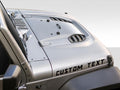
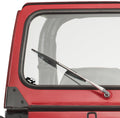
The TJ hardtop has a distinctive set of side and rear windows, so window graphics cut for a JL or a JK will not fit. Ours are cut specifically for the 1997-2006 TJ hardtop.


Both are ORACAL 651 cut vinyl, made in our South Carolina shop, and available in the full color range. Our TJ decals guide covers what fits where on this generation.
The verdict
The TJ is still worth buying for off-road, and the reasons don't show up in a spec comparison: short wheelbase, coil springs, solid axles, a torquey iron engine, and a truck simple enough that you can fix it yourself. Check the frame before anything else, and walk away from a rusty one no matter how good the rest of it looks. Then buy a six-cylinder, buy a 2003 to 2006 if you can, and buy a Rubicon if you can stretch.
Then go get it unstuck. Our guide to choosing between a kinetic rope, a snatch strap, and a winch covers getting it unstuck again, and how to actually run a winch picks up from there.
Specifications checked September 2026 against published sources. Values are Hagerty guide figures for vehicles in good condition and will vary by region, condition, and rust.
Frequently asked questions
Is a Jeep Wrangler TJ still good off-road in 2026?
Yes, and in some ways it is better than what replaced it. It is short at a 93.4-inch wheelbase, narrow, light, and it rides on coil springs at all four corners. On tight, technical trails, those things matter more than horsepower or electronics, which is why TJs are still everywhere on hard trails almost twenty years after the last one was built.
What years is the Jeep Wrangler TJ?
Model years 1997 through 2006. Production ran from January 1996 to July 2006. The Unlimited, known as the LJ, arrived in April 2004 with a 103.4-inch wheelbase, ten inches longer than the standard TJ.
Which TJ year is the best to buy?
For off-road use, 2003 through 2006, and a Rubicon if you can afford one. Those years brought the 42RLE four-speed automatic, and the Rubicon added front and rear air-actuated locking Dana 44 axles with the Rock-Trac 4:1 transfer case. That is factory equipment you would otherwise spend thousands on to add to a lesser TJ.
Is the Jeep 4.0 engine really that reliable?
It has earned the reputation. It is a cast-iron inline six making 190 horsepower and 235 pound-feet; it runs a timing chain rather than a rubber belt, and its torque arrives low where wheeling actually uses it. It is also simple enough to work on in a driveway, which matters as much as the engineering when a truck is twenty years old.
What is the 0331 cylinder head problem?
Some 4.0 engines from roughly 2000 and 2001 use a cylinder head with the casting number 0331 that owners and independent shops widely report cracking between cylinders three and four. Jeep never issued a recall, so there is no official documentation, and the reported years vary. Check the casting number stamped on the head and look for oil in the coolant rather than relying on the model year.
How much should a Jeep Wrangler TJ cost?
Hagerty puts a 1997 to 2006 TJ in good condition at around $12,400 on average, and a 2006 Unlimited Rubicon in good condition closer to $25,033. Values have held up rather than fallen, so a TJ is one of the few off-road vehicles you can use hard without watching the money evaporate.
What should I check before buying a TJ?
The frame first, specifically the rear section behind the fuel tank, the rear shackle mounts, and the front lower control arm mounts. Then the cylinder head casting number, the coolant for oil, and which transmission it has. Rust is the one problem on this list that can total the vehicle.
0 comments