



The Jeep started as a wartime contract in 1940 and became the most recognizable off-road vehicle in the world. What follows is the complete timeline from the WWII Willys MB to the current JL Wrangler, including every major generation, the story behind the seven-slot grille, and how the Easter egg tradition began.
In this article
- Born for war: the Willys MB (1941)
- Peacetime pioneer: the CJ series
- Jeep generations at a glance
- The modern era: Wrangler and Gladiator
- The seven-slot grille and hidden Easter eggs
- A culture of customization
- Frequently asked questions
Born for War: The Willys MB (1941)
In June 1940, the U.S. Army Quartermaster Corps issued a request for a lightweight reconnaissance vehicle to 135 manufacturers. The specs were demanding: deliver a working prototype in 49 days, keep it under 1,300 lbs, and make it capable of carrying a 600-lb payload. Only three companies responded: American Bantam, Willys-Overland, and Ford.
American Bantam built the first prototype on time. All three designs were tested, refined, and eventually consolidated into a single spec. Willys-Overland won the main production contract with the Willys MB, powered by the 60-hp "Go Devil" four-cylinder. Ford built an identical vehicle, the GPW, under license. Parts from both are fully interchangeable.
More than 640,000 were built between 1941 and 1945. The little 4x4 served every theater of the war. General Eisenhower later named it one of "three decisive weapons the U.S. had in World War II." The name "Jeep" caught on informally among soldiers, likely a shortening of "GP" (General Purpose), and Willys later trademarked it for civilian use.
Peacetime Pioneer: The CJ Series
Willys understood that soldiers coming home would want to keep driving the same vehicle. In 1945 they launched the CJ-2A (Civilian Jeep), which kept the fold-down windshield and flat fenders of the MB but added a tailgate, a side-mounted spare, and a power take-off for farm equipment. It sold to farmers, ranchers, and weekend explorers for $1,090.
The CJ line ran for four decades through six major variants. The CJ-5 (1955) was the most produced civilian Jeep ever, with rounded styling based on the military M38A1. The CJ-7 (1976) added an optional automatic transmission and a factory hardtop for the first time. By 1986 the CJ was retired and replaced by the newly named Wrangler as Jeep adapted to modern safety standards.
Jeep Generations at a Glance
| Generation | Years | What Changed |
|---|---|---|
| MB / GPW | 1941-1945 | WWII military vehicle; the original Jeep |
| CJ-2A | 1945-1949 | First civilian model; added tailgate and side spare |
| CJ-5 | 1955-1983 | Rounded styling; most produced CJ ever |
| CJ-7 | 1976-1986 | Optional automatic trans; factory hardtop option |
| YJ Wrangler | 1987-1995 | Square headlights (controversial); wider track |
| TJ Wrangler | 1997-2006 | Round headlights return; coil-spring front suspension |
| JK Wrangler | 2007-2018 | 4-door Unlimited joins the lineup |
| JL Wrangler | 2018-present | Turbocharged 4-cylinder; 4xe plug-in hybrid option |
| JT Gladiator | 2020-present | Wrangler-based pickup; first Jeep truck since 1992 |
The Modern Era: Wrangler & Gladiator
The 1987 YJ was the first to officially wear the Wrangler name. Its square headlights divided the fanbase, but a wider track and improved road manners won over buyers who used their Jeeps daily. The 1997 TJ corrected the most controversial decision: round headlights came back, and coil-spring front suspension replaced leaf springs, giving the TJ dramatically better wheel articulation both on and off road.
The 2007 JK introduced the four-door Unlimited body, which now outsells the two-door consistently. The current JL (2018) added a turbocharged 2.0L four-cylinder and, starting in 2021, the 4xe plug-in hybrid drivetrain that delivers more low-end torque on the trail than any previous Wrangler engine. The 2020 JT Gladiator brought back the Jeep pickup concept absent since the Comanche ended production in 1992.
The Seven-Slot Grille & Hidden Easter Eggs
The seven-slot grille goes back to the original Willys MB. The Army specified seven slots to distinguish the Willys from the Ford GPW, which used a solid bar grille. That number became a Jeep signature, appearing on every model ever produced. Stellantis (Jeep's current parent company) actively defends it as a registered trademark against competitors who attempt to copy the design.
The Easter egg tradition is newer. It started with the TJ generation in the late 1990s, when Jeep designers began hiding small illustrations in body stampings, glass, and trim. Current JL Wranglers have over a dozen, including a Willys MB stamped into the cowl, a gecko on the windshield A-pillar, and a flip-flop stamped into the rear wheel well. Jeep officially acknowledges the Easter eggs and publishes clues encouraging owners to find them.
Full stories: Why Do Jeeps Have 7 Slots in the Grille? and Hidden Jeep Easter Eggs.

Five Willys-era icons in precision-cut vinyl. A nod to where every Jeep came from.
A Culture of Customization
Personalizing a Jeep is as old as the vehicle itself. WWII soldiers painted nicknames and unit insignia on their MBs. Postwar farmers bolted winches and snowplows onto their CJs. The YJ and TJ eras built an entire aftermarket industry around lift kits, tube bumpers, and vinyl graphics. The JL generation now supports the widest range of factory and aftermarket personalization in the model's history.
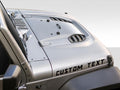
From hand-painted stars on 1941 hoods to precision-cut vinyl graphics today, Jeep owners have always made their rigs their own. Browse our Hood Graphics & Decals, Fender Decals & Graphics, and Tire Covers to continue the tradition.

Put your Jeep's name on the hood. Your font, your color, cut vinyl, outdoor-rated.
Add your own chapter to 85 years of Jeep history
Custom vinyl graphics for every Jeep, every generation. Ships in 2-3 business days.
Shop Hood Graphics →Frequently asked questions
What does "Jeep" stand for?
The origin of the name is genuinely disputed. The most widely cited theory is that soldiers shortened "GP" (General Purpose or Government Purpose) into "Jeep" informally during WWII. A competing theory traces the name to Eugene the Jeep, a magical character in the Popeye comic strip known for going anywhere. The Army had no single official name for the vehicle; "Jeep" caught on in the field. Willys-Overland later trademarked the name for civilian use.
Who built the original Jeep?
Three companies submitted prototypes in response to the 1940 Army contract: American Bantam, Willys-Overland, and Ford. American Bantam built the first working prototype within the required 49 days. After testing, Willys-Overland won the primary production contract with the MB. Ford built an identical model (the GPW) to the same Willys specifications. Willys is credited as the original Jeep manufacturer and held the trademark after the war.
What year did the Wrangler replace the CJ?
The Wrangler YJ launched for the 1987 model year, officially replacing the CJ line. The last CJ-7 rolled off the line in 1986. The changeover was driven by tightening safety regulations and Jeep's need to modernize for a broader market. The YJ kept the same body-on-frame construction, solid front axle, and removable top as the CJ, just under a new name.
Why do Jeeps have 7 slots in the grille?
The Army specified seven slots for the Willys MB to distinguish it from the Ford GPW's solid bar grille. The number became a Jeep trademark that has appeared on every model since 1941. Stellantis actively defends it in court against competitors who copy the design. The full origin story is in: Why Do Jeeps Have 7 Slots in the Grille?
What are the hidden Easter eggs on a Jeep?
Easter eggs are small illustrations hidden by Jeep designers in body stampings, glass, and trim. The tradition started during the TJ generation in the late 1990s. Current JL Wranglers have over a dozen, including a Willys MB stamped into the cowl and a gecko on the windshield A-pillar. Jeep officially acknowledges the Easter eggs and publishes clues for some of them.
How many Jeeps were built during World War II?
More than 640,000 military Jeeps were produced between 1941 and 1945. Willys-Overland built approximately 363,000 MB units and Ford built roughly 277,000 GPW units. Both were built to identical specifications and parts are fully interchangeable. Original WWII Jeeps in running condition are sought-after collector vehicles; restored examples regularly sell for $20,000 to $40,000 or more.
0 comments