



Every overlander has done this math in a gas station parking lot. Tank is at a quarter, the next town is ninety miles out, and you are trying to remember whether the last fill-up was better or worse than you expected.
The usual answer people give is bigger tires. It is almost always wrong. A controlled test published on September 7, 2026 measured it properly, and the thing costing you the most range is not on your axles. It is above your cab.
Start with the number that actually matters
A 2026 Jeep Gladiator with the 3.6L V6, eight speed automatic and four wheel drive is rated by the EPA at 17 city, 22 highway, 19 combined, and it carries a 22.0 gallon tank.
Miles per gallon is an abstraction. Range is the thing you plan around. Here is what each figure is worth on a full 22 gallon tank:
| Observed mpg | Full tank range | Planning range at 85 percent |
|---|---|---|
| 22 (EPA highway) | 484 miles | 411 miles |
| 19 (EPA combined) | 418 miles | 355 miles |
| 17 | 374 miles | 318 miles |
| 15 | 330 miles | 280 miles |
| 13 | 286 miles | 243 miles |
| 11 | 242 miles | 206 miles |
That is arithmetic on the published tank size, not a measurement of any particular truck. But it shows the shape of the problem. The gap between a stock highway run and a fully built rig is not a few dollars at the pump. It is the difference between clearing a two hundred mile empty stretch and not clearing it.
Where the test came from
The data below is not ours. It comes from Practical 4X4 Aerodynamics That ACTUALLY Works, published September 7, 2026 by Tinkerer's Adventure, who ran back to back fuel loops on a Toyota Tundra and then had the configurations simulated by AirShaper, the cloud aerodynamics firm founded in 2017 by Wouter Remmerie.
Two honest caveats before the numbers. It is a Tundra, not a Gladiator, so treat the percentages as the transferable part and not the absolute mpg. And the road testing was three loops on one stretch of highway on a single low wind day, which is a real test but not a laboratory. The simulation work is what gives the road results their backbone.
The tire myth, measured
He bought a set of factory 32s specifically to run a stock baseline, then swapped to 37s and ran the same 55.3 mile loop.
- Factory 32s: 17.4 mpg at the pump
- Skinny 37s, high offset factory wheels: 17.4 mpg once corrected for the speedometer error the bigger tires introduce
Essentially no difference. The simulation explains why, and it is the most useful thing in the whole test:
| Setup | Drag at 70 mph | Change |
|---|---|---|
| Stock 32s | 214 lb | baseline |
| Skinny 37s, high offset | 224 lb | plus 4.6 percent |
| Wide 37s with poke | 243 lb | plus 13.6 percent |
Diameter is not the problem. Width and offset are. Pushing the tire out into clean air past the fender is what costs you, because an exposed rotating tire throws turbulent air down the whole side of the vehicle. Remmerie makes the point in the video that it is not only drag at the wheel, it is the quality of the airflow everywhere downstream of it.
So when somebody tells you their mileage collapsed after going to 37s, the tires are usually taking the blame for the bumper, the lift and the wheel offset that arrived at the same time.
The rest of the underbody mods
Measured against the same baseline:
- Full replacement front bumper: plus 19 lb, about 8.5 percent
- Three inch lift: roughly the same again
- A partial cut bumper: plus 6.5 lb, about 2.9 percent, the smallest change he measured
All three of the big ones do the same thing, which is expose more spinning tire to open air. Run all three together and drag rose 21.4 percent, slightly less than adding them up individually.
What this looks like on our own Gladiator
We are not writing this from the outside. Our Gladiator runs 37s, a 3.5 inch lift, and steel front and rear bumpers, and its lifetime average sits at 13.4 mpg.
Against the EPA combined figure of 19, that is about 29 percent down. On the 22 gallon tank it works out like this:
| mpg | Full tank | Planning range | |
|---|---|---|---|
| EPA combined | 19 | 418 miles | 355 miles |
| Ours, as built | 13.4 | 295 miles | 251 miles |
That is 105 planning miles gone. Not money at the pump. Miles.
Now look at which mods those are. A lift. A replacement front bumper. Larger tires. Those are exactly the three the simulation grouped together and measured at plus 21.4 percent drag as a combination.
And on the tire question specifically, we are the expensive version of it. Our tires sit roughly two inches proud of the fender flares. That is not the 4.6 percent configuration from the test. That is the 13.6 percent one.
This is worth being precise about, because it is the single most misunderstood point in the whole subject. Going from 32s to 37s barely registered in the test. Going from a tucked tire to one standing two inches out in open air more than tripled the penalty. Our mileage problem is not that the tires are tall. It is that they are wide and pushed out. Same tire diameter, different wheel, and a meaningful amount of that 105 miles comes back.
Three honest qualifications, because our number is not a clean experiment.
First, 13.4 is a lifetime mixed average, not a steady highway run. Aerodynamic drag scales with the square of speed, so it dominates on the highway and explains much less around town. Some of our shortfall is simply mass. Steel bumpers at both ends are a lot of weight to accelerate away from every stop sign, and weight is a fuel cost that has nothing to do with air.
Second, and this fits the pattern in the rest of this article: the rear bumper is sitting in air that already separated from the vehicle at the tailgate. It is costing us weight rather than drag. The front one is out in clean air, which is where the aerodynamic bill gets run up.
Third, we are on mud terrain tires, and that is a separate bill again. Aggressive tread blocks with big voids between them, plus the heavier casing that comes with a real mud tire, raise rolling resistance compared with an all terrain in the same size. Rolling resistance is not aerodynamics and it does not care how fast you are going, so it costs you in town as well as on the highway. If your mileage disappointed you after a tire change, be honest about whether you changed diameter or changed compound and tread pattern, because those are two different decisions and only one of them is about air.
So our 13.4 is three bills arriving together: air, weight, and rubber. The test in this article isolates the first one. It is the largest of the three at highway speed, and it is the only one you can fix by moving something rather than removing it.
The part that actually stings
Our roof rack only goes on for camping trips. It comes off for daily driving.
Which means the biggest drag penalty in this entire article gets added precisely on the trips where we are farthest from a gas station. Best range on the school run, worst range crossing an empty stretch of highway with a tent on the roof.
That is backwards, and until we ran these numbers we had never thought about it in that order. If you carry a rack seasonally, your fuel planning needs to be built around your loaded configuration, not the average on your dash.
Now the part that actually decides your range
Here is the finding worth rearranging a build around. He ran the same rooftop tent in two positions on the same truck.
- Tent mounted low, below the cab line: almost no measurable penalty
- Tent raised about two inches above the cab: the single largest drop in the entire test, roughly three miles per gallon
Moving that identical tent back down recovered close to 90 percent of the loss.
Sit with that. One tent, one truck, same weight, same fabric. The only variable was height relative to the roofline, and it was worth more than three aggressive off-road mods stacked together.
The mechanism is frontal area. Raised above the cab, the tent had a better drag coefficient, meaning a cleaner shape, but it presented far more area to the wind, so total drag went up anyway. Tucked behind the cab it adds almost no new frontal area at all.
If you are weighing a tent decision more broadly, our rooftop tent versus ground tent comparison covers the parts of that tradeoff that have nothing to do with airflow.
The counterintuitive one: enclosing the gap helped
He then simulated the same tent on a camper shell instead of an open rack, expecting the flat front wall to catch more wind. It did the opposite. Drag dropped about 5 percent.
The front wall stopped turbulent air from tumbling into the open gap between cab and tent, effectively acting as a built in air dam. It is a case of something downstream improving the flow upstream of it, which is common in aerodynamics and deeply unintuitive if you have not seen it before.
And a genuine physical air dam? He modeled a large aggressive one. It bought about 2 percent. Remmerie's explanation is that a dam only works if it has a convex profile that ends tangentially to whatever sits behind it, top and sides, with smooth transitions. A flat plate mostly just spins air off its edges into vortices. Most of what is sold to overlanders is a flat plate.
What this means for a Gladiator build
The Gladiator is the Jeep this matters most to, because it has the one thing a Wrangler does not: a bed, a cab, and a gap between them that you get to decide what to do with.
- Decide the roofline first. Everything else is a rounding error next to whether your sleeping platform sits above or behind the cab. Make this decision before you buy anything.
- If it has to be a rooftop tent, get it low. Bed rack height is a fuel range decision, not just a clearance one.
- A cab height topper or wedge camper is the efficient answer, because it closes the gap instead of leaving it open to tumbling air.
- Choose wheel offset deliberately. A high positive offset with a narrower tire is close to free. Poke is expensive.
- Spend the savings where you want them. Keep the roofline clean and you have budget for the bumper and the lift that actually change what you can drive.
One thing the test deliberately set aside is gearing. Running tall tires on stock gears made his transmission hunt on climbs, which is its own fuel penalty separate from air. If you are on 37s with factory gears, our gear ratio calculator will tell you what you actually need.
What about the spare, and everything else on the back?
Short version: it is not where your range went. Anything mounted at the rear is already sitting in air that separated from the vehicle at the tailgate, which is why we have never put a fuel economy percentage on a tire cover. Nobody can honestly measure that, and this test is a good illustration of why. The measurable effects all sit in clean air, up high and out front.
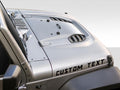
What a cover genuinely does is keep sun and road grime off a tire that mostly sits still. If you want yours to say something, that is what our spare tire covers and the Gladiator decal collection are for. Neither will change your mileage, and we are not going to pretend otherwise.
The honest summary
Aerodynamic drag rises with the square of your speed, so all of this is a highway problem and almost none of it matters on a trail. But highway miles are how you get to the trail, and range is how far you can go before the trip becomes a fuel logistics exercise.
If you take one thing: the roofline is the decision. Everything else is detail.
Watch the full test at Tinkerer's Adventure. It is worth your time, and the simulation footage explains the airflow far better than words do.
Frequently asked questions
Do 37 inch tires really hurt fuel economy?
Far less than people assume, if they are narrow and run a high positive offset. In the September 2026 test, skinny 37s added about 4.6 percent drag over stock 32s and returned essentially identical corrected fuel economy. Wide 37s with poke added 13.6 percent. Width and offset matter more than diameter.
How much fuel economy does a rooftop tent cost?
It depends almost entirely on height. In that test, a tent raised about two inches above the cab was the single biggest penalty measured, roughly three miles per gallon. The same tent moved below the cab line recovered close to 90 percent of that loss.
What is the range of a 2026 Jeep Gladiator?
The EPA rates the 2026 Gladiator 4WD with the 3.6L V6 and eight speed automatic at 17 city, 22 highway and 19 combined, with a 22.0 gallon tank. That is 484 highway miles on a full tank in theory. Plan on roughly 85 percent of any figure so you are not running the tank dry.
Does a spare tire cover affect gas mileage?
Not measurably. A rear mounted spare already sits in separated, turbulent air behind the vehicle, so a fabric cover over it changes almost nothing. Anyone quoting you a specific percentage for a tire cover is guessing.
Do overland air dams and wind deflectors work?
Rarely, as sold. A large simulated air dam produced only about a 2 percent improvement. An effective one needs a convex profile ending tangentially to the object behind it on both the top and sides, with smooth transitions. Most products on the market are flat plates, which shed air off their edges into vortices instead of guiding it.
Is a camper shell better than a bed rack for fuel economy?
In simulation, yes. Putting the same tent on an enclosed camper instead of an open rack reduced drag about 5 percent, because the closed front wall stopped turbulent air from filling the gap between cab and tent. A low camper that stays behind the cab line was the only configuration in that test to beat the stock baseline.
0 comments